


What Is Field Sales Management Software?
Field sales management software is a digital solution that helps businesses manage sales representatives who work outside a traditional office environment.
These representatives may visit retail outlets, meet distributors, generate orders, maintain customer relationships, and collect information about market demand.
The software helps businesses organize these activities through tools designed to support sales teams and their managers. Depending on the platform, common capabilities may include:
• Customer and account management.
• Sales representative activity tracking.
• Customer visit planning and recording.
• Sales order management.
• Sales performance reporting.
• Inventory visibility.
• Sales analytics and dashboards.
• Mobile access to sales information.
• Customer follow-up management.
Not every platform includes all these features, so businesses should evaluate solutions according to their operational requirements. The primary objective is to make field sales operations more organized, improve access to information, and reduce the administrative burden associated with managing a distributed sales team.
10 Benefits of Using Field Sales Management Software
1. Increased Sales Team Productivity
One of the biggest advantages of field sales management software is its ability to help representatives use their working hours more effectively.
Field sales employees often spend time on activities beyond selling, including updating spreadsheets, preparing reports, searching for customer information, recording orders, and communicating routine updates to managers.
When these processes are manual or spread across multiple systems, they can interrupt the sales workflow and reduce the time available for customer interactions.
Field sales management software helps organize these activities in one place, depending on the features available.
How it improves productivity:
• Makes relevant customer information easier to access.
• Simplifies the process of recording sales activities.
• Reduces repetitive administrative tasks.
• Helps representatives organize customer visits.
• Makes order-related information easier to manage.
• Improves coordination between field representatives and managers.
For example, imagine a sales representative who visits several retail outlets every day. If the representative must manually record every visit, update a spreadsheet, and send a separate report to the manager, administrative work can accumulate quickly. A more organized digital workflow can reduce duplicate data entry and make information easier to retrieve.
This allows representatives to devote more attention to understanding customer needs, discussing products, and generating orders.
Business benefit: Better-organized workflows can help businesses make more effective use of their sales team's time and resources.
2. Better Visibility Into Field Sales Activities
Managing employees who work across different locations can be challenging. Sales managers may not always know which customer visits have been completed, whether planned activities are progressing as expected, or where representatives need additional support.
Without reliable information, managers may have to depend on phone calls, messages, and end-of-day reports to understand field activities.
Field sales management software can improve visibility by providing structured records of sales activities and customer visits.
How it improves visibility:
• Helps managers review planned and completed activities.
• Provides a clearer picture of customer visit coverage.
• Makes sales activity records easier to access.
• Helps identify missed visits and recurring delays.
• Supports more consistent reporting.
• Enables managers to investigate operational issues more effectively.
For example, if a representative repeatedly misses scheduled customer visits, a manager can review the available activity records and discuss the underlying reasons. The problem might involve unrealistic scheduling, customer availability, unexpected travel delays, or competing responsibilities.
Instead of relying on assumptions, managers can use available information to identify the issue and offer practical support. It is important to use activity tracking transparently and responsibly, with appropriate attention to employee privacy and applicable laws.
Business benefit: Better visibility helps managers understand field operations and make more informed decisions about team support and performance.
3. Improved Sales Performance Tracking
Sales performance is easier to improve when businesses can measure results consistently. However, when sales information is collected through separate spreadsheets, handwritten notes, and delayed reports, evaluating team performance can become time-consuming.
Field sales management software can help centralize sales activity and performance information, making it easier for managers to review relevant metrics.
Important sales metrics include:
• Sales revenue by representative.
• Number of customer visits completed.
• Number of orders generated.
• Order conversion rate.
• Average order value.
• Customer retention rate.
• Sales performance by territory.
• New customer acquisition.
By reviewing these metrics together, managers can understand not only how much their teams are selling but also how effectively they are using their time.
For instance, one representative may complete many customer visits but generate relatively few orders. Another may complete fewer visits while achieving higher revenue. These differences can help managers identify opportunities for coaching, changes in customer prioritization, or improvements in sales processes.
Performance metrics should always be interpreted in context. Territory size, customer demand, product availability, and differences in account portfolios can all influence results.
Business benefit: Consistent performance tracking helps businesses identify strengths, address gaps, and develop more effective sales strategies.
4. Streamlined Sales Order Management
Order management is a critical part of field sales, particularly for businesses that sell products through distributors, wholesalers, retailers, and other business customers.
When orders are recorded manually or transferred between disconnected systems, errors and delays can occur. Representatives may enter incorrect quantities, overlook product details, or spend unnecessary time confirming information with the back office.
Digital order management can help organize the process from order entry to subsequent processing.
How software can simplify order management:
• Provides structured order-entry workflows.
• Makes customer and product information easier to access.
• Helps reduce duplicate data entry.
• Improves the consistency of order records.
• Makes order information easier to review.
• Supports coordination between sales and operations teams.
For example, a representative visiting a retail outlet may need to record an order containing several products and quantities. A structured digital process can make it easier to capture those details consistently and share the information with the relevant team.
The business can then use its established order-processing and fulfillment procedures to complete the transaction. The exact benefits depend on whether the software integrates with inventory, invoicing, accounting, and fulfillment systems.
Business benefit: More organized order management can reduce administrative friction, improve information accuracy, and help businesses process customer orders more efficiently.
5. Stronger Customer Relationship Management
Successful field sales depends on building and maintaining customer relationships. Representatives need to understand customer preferences, purchasing patterns, previous conversations, outstanding concerns, and future requirements.
When customer information is scattered across notebooks, messaging applications, and individual spreadsheets, maintaining a consistent customer experience becomes difficult.
Field sales management software can help centralize relevant customer information and make it more accessible to authorized team members.
How it supports customer relationships:
• Keeps customer records organized.
• Helps representatives review relevant account information.
• Makes previous interactions easier to reference.
• Supports more consistent follow-up processes.
• Helps teams identify inactive or declining accounts.
• Improves coordination when multiple employees serve the same customer.
Consider a retailer who regularly orders specific products but has not placed an order during the usual purchasing period. With access to appropriate customer and sales records, the representative can follow up to understand whether the retailer needs replenishment, has encountered a service issue, or is experiencing a change in demand.
This creates an opportunity to address customer concerns instead of waiting for the customer to initiate contact. Good customer relationships still depend on communication, trust, and service quality. Software supports these activities but does not replace them.
Business benefit: Organized customer information helps sales teams provide more consistent service and identify opportunities to strengthen customer relationships.
6. Reduced Manual Work and Administrative Errors
Manual processes often become harder to manage as sales teams grow. A representative may record a customer visit in one document, enter an order in another system, and prepare a separate report for the manager. Repeatedly entering the same information increases administrative effort and creates opportunities for mistakes.
Field sales management software can reduce some of this friction by providing structured digital workflows.
Examples of administrative tasks that may be simplified include:
• Recording customer visits.
• Maintaining customer information.
• Entering sales orders.
• Updating sales activity records.
• Preparing routine sales reports.
• Organizing follow-up tasks.
• Reviewing sales performance.
For example, when sales information is captured digitally at the point of activity, representatives may not need to recreate the same records at the end of the day. Similarly, standardized digital forms can help teams collect information consistently.
Digitization alone does not guarantee accuracy. Businesses still need clear processes, appropriate permissions, data validation, and employee training.
Business benefit: Reducing repetitive work and improving data consistency can help sales teams spend less time on administration and more time on productive activities.
7. Faster, Data-Informed Business Decisions
Sales managers frequently need to make decisions about territory performance, customer demand, team priorities, and operational challenges. When information is incomplete or arrives too late, managers may have difficulty identifying problems before they affect business results.
Field sales management software with appropriate reporting and analytics capabilities can help businesses access useful information more systematically.
How sales data supports better decisions:
• Identifies changes in sales performance.
• Highlights differences between territories.
• Helps evaluate customer purchasing patterns.
• Reveals recurring order-related issues.
• Supports sales target reviews.
• Helps managers identify areas that require attention.
• Provides evidence for operational improvements.
For example, a distributor may notice that orders for a particular product category have declined across several territories. Rather than immediately assuming that representatives are underperforming, managers can investigate possible explanations, such as product availability, changing customer demand, pricing, or competitor activity.
The quality of these decisions depends on the accuracy, completeness, and timeliness of the underlying information.
Business benefit: Better access to sales information can help managers identify trends, investigate problems, and make decisions based on evidence rather than assumptions.
8. Improved Coordination Between Sales Representatives and Managers
Field sales representatives often work independently across different locations, while sales managers and back-office teams operate from a central office. Without clear communication processes, information can become fragmented.
Managers may struggle to obtain timely updates, representatives may not receive the information they need, and operational issues can take longer to resolve.
Field sales management software can help improve coordination by organizing relevant sales information and activities in a shared workflow.
How it improves coordination:
• Makes sales activity information easier to access.
• Helps standardize reporting procedures.
• Supports clearer communication about customer requirements.
• Improves visibility into order-related activities.
• Helps managers identify issues requiring follow-up.
• Makes it easier to coordinate sales priorities.
For example, a representative may identify a customer request that requires action from the operations team. When the request is recorded and shared through an appropriate workflow, the relevant team can review it without depending entirely on informal messages or verbal updates.
The exact communication capabilities vary by platform, so businesses should verify which collaboration and notification features are available.
Business benefit: Better coordination can reduce information gaps and help teams respond to operational requirements more consistently.
9. Better Inventory and Product Availability Visibility
For businesses in FMCG, wholesale, retail distribution, and related industries, product availability can directly affect sales opportunities. A representative may identify customer demand but be unable to complete an order because the requested products are unavailable.
Limited inventory information can also make it harder to recommend alternatives or communicate realistic delivery expectations.
When field sales software provides relevant inventory visibility or connects with an inventory management system, representatives can make better-informed decisions during customer interactions.
How inventory visibility can help:
• Makes relevant stock information easier to access.
• Helps representatives identify unavailable products.
• Supports more informed product recommendations.
• Improves communication between sales and inventory teams.
• Helps businesses identify recurring stockout patterns.
• Provides information that can support replenishment planning.
For example, if a retailer requests a product that is temporarily unavailable, access to reliable stock information can help the representative explain the situation and discuss suitable alternatives. Over time, sales and inventory data may also help businesses identify frequently requested products and recurring availability problems.
Accurate inventory visibility depends on reliable stock records and timely system updates. Not all field sales management platforms provide inventory functionality directly, so businesses should confirm whether this feature is included or requires an integration.
Business benefit: Better inventory information can help sales teams respond to customer requirements and reduce avoidable friction during order taking.
10. Greater Scalability as Your Business Grows
A sales process that works for a small team may become difficult to manage when the business expands. More representatives, customers, orders, and territories create additional coordination and reporting requirements.
Without structured systems, managers may find themselves spending increasing amounts of time consolidating information and resolving administrative problems.
Field sales management software can help businesses establish more consistent processes that support growth.
How software can support scalability:
• Standardizes sales workflows.
• Organizes customer and order records.
• Supports consistent performance reporting.
• Makes information easier to share across teams.
• Helps managers evaluate activity across territories.
• Reduces dependence on individual spreadsheets.
• Provides a more structured foundation for operational growth.
For example, a distributor expanding into new territories may need to maintain consistent customer records, order procedures, and performance measures across several sales teams. A centralized sales management platform can help establish common processes while giving managers visibility into the information relevant to their responsibilities.
When evaluating scalability, businesses should consider user limits, pricing, mobile usability, integrations, reporting requirements, data security, and the effort needed to onboard new employees.
Business benefit: A well-chosen platform can help businesses maintain more organized sales operations as their teams and customer bases expand.
How SalesRoute.ai Can Help Businesses Improve Field Sales Management
Understanding the benefits of field sales management software is the first step. The next is finding a solution that aligns with your business requirements.
SalesRoute.ai is a platform businesses can explore when looking to organize and streamline field sales operations. Depending on the features available in their configuration, businesses can use the platform to support workflows related to sales route planning, field activities, customer visits, order management, and sales performance visibility.
These capabilities can contribute to a more structured approach to field sales management.
For example, businesses may be able to use digital workflows to organize customer visits, maintain relevant sales records, and improve visibility into sales activities. Where the appropriate features are available, managers can use sales information to review performance and identify areas for improvement.
Before adopting any platform, it is important to assess your business requirements and confirm which capabilities are currently available.
Consider the following questions:
• Can the platform support your existing sales processes?
• Does it provide the customer and order management features you need?
• Can representatives use it effectively while working in the field?
• Does it provide the reports and performance indicators your managers require?
• Can it integrate with your existing systems, where necessary?
• Does the pricing fit your budget and expected growth?
• What onboarding, training, and support are available?
The best field sales management software is not necessarily the one with the most features. It is the one that solves your most important operational problems and is practical for your team to use consistently.
SalesRoute.ai is worth evaluating against these requirements to determine whether it is a good fit for your business.
How to Choose the Right Field Sales Management Software
Before investing in field sales management software, businesses should establish clear selection criteria.
1. Identify Your Biggest Sales Challenges
Start by identifying the problems you want to solve. Are representatives spending too much time on manual reporting? Is order processing inefficient? Do managers lack visibility into sales activities? Are customer records difficult to maintain? Prioritize solutions that directly address these challenges.
2. Evaluate Essential Features
Compare the available capabilities of different platforms. Depending on your business model, you may need customer management, order processing, field activity tracking, sales reporting, inventory visibility, or route planning. Focus on features that support your daily operations rather than selecting software based on an unnecessarily long feature list.
3. Consider Ease of Use
Field sales representatives need tools that fit naturally into their working routines. A complicated interface or time-consuming data-entry process may discourage adoption and undermine the benefits of digitization. Look for a solution that is intuitive, mobile-friendly, and suitable for the conditions in which your team works.
4. Check Reporting and Analytics
Make sure the platform provides the information managers need to monitor performance and make decisions. Check whether the available reports cover your most important sales KPIs and whether the information can be accessed and exported as required.
5. Assess Integration Requirements
Your business may already use accounting software, inventory systems, ERP platforms, or CRM tools. Determine whether the field sales management software integrates with these systems and whether additional implementation work or costs are involved.
6. Review Pricing and Scalability
Consider the total cost of ownership, including subscriptions, implementation, integrations, training, and support. Choose a solution that meets your current needs while remaining practical as your team grows.
7. Evaluate Data Security and Support
Customer information and sales records are valuable business assets. Review the provider's security practices, access controls, data handling policies, and support arrangements before making a decision.
Taking these steps helps businesses select a platform based on practical value rather than marketing claims alone.
Conclusion
Field sales management software can help businesses create more organized, efficient, and data-informed sales operations.
From improving team productivity and monitoring performance to simplifying order management and strengthening customer relationships, the right platform can address many of the challenges associated with managing a distributed sales team.
The 10 benefits discussed in this article demonstrate how digital sales workflows can support better coordination, reduce repetitive administrative work, improve access to information, and provide a more structured foundation for business growth.
However, technology alone is not enough. Businesses also need clear sales processes, realistic targets, effective coaching, accurate data, and consistent employee adoption.
When these elements work together, field sales management software becomes more than a reporting tool. It becomes part of a broader strategy for helping sales teams operate effectively and serve customers better.
If your business is looking to improve how it manages field sales activities, explore SalesRoute.ai to evaluate how its available features align with your sales management needs.
Start by identifying your biggest operational challenges, comparing relevant capabilities, and selecting a solution that helps your team work more effectively today while preparing for future growth.
SEO Details for Publishing
SEO Title
10 Benefits of Field Sales Management Software for Your Business
Meta Description
Discover 10 benefits of field sales management software, from improved productivity and order management to better sales tracking and business growth.
URL Slug
benefits-of-field-sales-management-software
Primary Keyword
Benefits of field sales management software
Secondary Keywords
Field sales management software; field sales automation; sales team management software; field sales productivity; sales performance tracking; sales order management.
Suggested Featured Image
A sales manager reviewing a digital sales dashboard while a field sales representative uses a mobile device to manage customer information and orders.
Suggested Image Alt Text
Field sales management software helping sales teams manage customer information, orders, and performance.
Recommended Internal Links
1. Field sales management — link to the relevant SalesRoute.ai feature or product page.
2. Order management — connect readers to relevant ordering capabilities.
3. Sales analytics — highlight reporting and performance visibility.
4. Route planning — mention route planning as one component of broader field sales management, rather than the main focus.
5. Contact or demo page — give interested readers a clear next step.
Before publishing, verify the exact features currently available in SalesRoute.ai. Adding an original example, a product screenshot, or a real customer result can make the blog more distinctive and credible.
Field Sales
10 Benefits of Using Field Sales Management Software for Your Business
Managing a field sales team involves much more than sending representatives out to meet customers. Sales managers must coordinate daily activities, monitor performance, manage customer relationships, process orders, and ensure that sales operations run smoothly. As businesses grow, these responsibilities become increasingly difficult to handle using spreadsheets, paper records, phone calls, and disconnected applications. Important customer information can get lost, sales reports may be delayed,
 Field Sales
Sales Order Management Made Simple with SalesRoute.ai
Managing expenses is an essential part of running a successful business. From travel costs and office purchases to operational expenses, every transaction impacts profitability. Without a structured system, tracking and analysing expenses can become time-consuming and prone to errors. SalesRoute.ai's Expense Management module helps organisations record, categorise, monitor, and analyse business expenses in one centralised platform. It provides better financial visibility
 Field Sales
How to Configure Corrective Maintenance in Odoo 19
The Maintenance application in Odoo 19 provides a centralized platform for managing company equipment, maintenance teams, repair requests, and maintenance schedules. It helps organizations keep their assets in good working condition while ensuring maintenance activities are planned and tracked efficiently. Corrective maintenance plays an important role in asset management by enabling businesses to respond quickly when equipment breaks down unexpectedly. With Odoo 19, maintenance requests can
 Field Sales
Sales Order Management Made Simple with SalesRoute.ai
Streamline Every Order, Improve Accuracy, and Deliver Faster
 Field Sales
5 Essential Mobile POS Strategies for Faster Van Sales Invoicing
Equipping field reps with offline-first billing, bluetooth thermal printing, and instant payment links drastically speeds up retail store checkouts.
 Stock Movement for FIFO and FEFO Inventory Allocation Stock Movement for FIFO and FEFO Inventory All
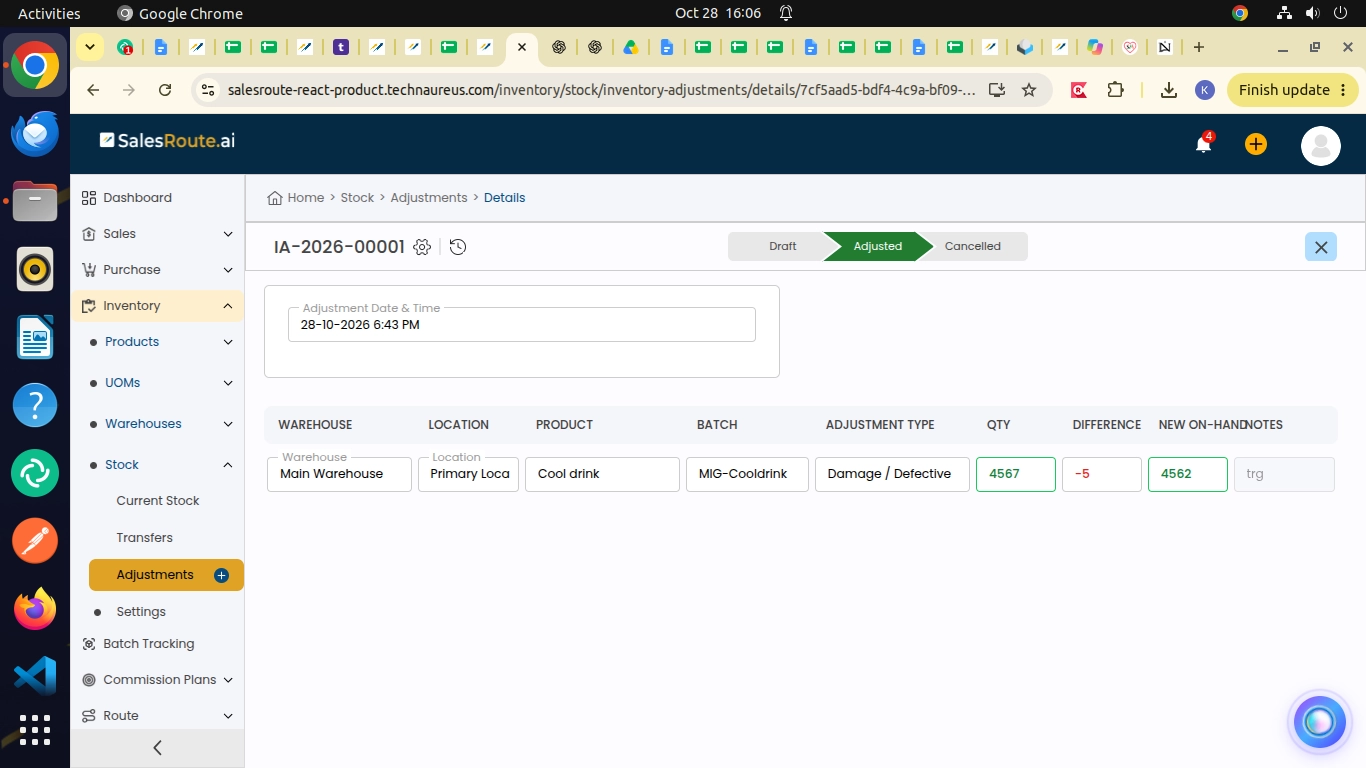
Inventory Management for Distributors: How to Track Stock, Receipts, Returns, and Adjustments
A sales rep confirms an order for 40 cases. The warehouse had 100, but 70 were already promised to other customers. Now the order is late, the customer is unhappy, and the team is hunting through spreadsheets to find out what went wrong. This is the most common inventory problem distributors face: the number on the screen does not match what can actually be sold. This guide explains how to keep that number honest, from purchase to delivery, returns, and adjustments.
 Distribution
Inventory Management Made Simpler with SalesRoute: From Stock Tracking to Smarter Business Decisions
Inventory is one of the most important parts of running a product-based business. Whether a company operates a warehouse, supplies retailers, distributes goods, or manages field sales, keeping track of stock is essential for smooth business operations. Too much inventory can block working capital, while insufficient stock can delay deliveries, interrupt sales, and disappoint customers. When inventory information is maintained manually or spread across different systems.
 Distribution
Inventory Management Made Simpler with SalesRoute: From Stock Tracking to Smarter Business Decisions
Inventory is one of the most important parts of running a product-based business. Whether a company operates a warehouse, supplies retailers, distributes goods, or manages field sales, keeping track of stock is essential for smooth business operations. Too much inventory can block working capital, while insufficient stock can delay deliveries, interrupt sales, and disappoint customers. When
 Distribution
Inventory Management Made Simpler with SalesRoute: From Stock Tracking to Smarter Business Decisions
Inventory is one of the most important parts of running a product-based business. Whether a company operates a warehouse, supplies retailers, distributes goods, or manages field sales, keeping track of stock is essential for smooth business operations. Too much inventory can block working capital, while insufficient stock can delay deliveries, interrupt sales, and disappoint customers. When inventory information is maintained manually or spread across different systems.
 AI features
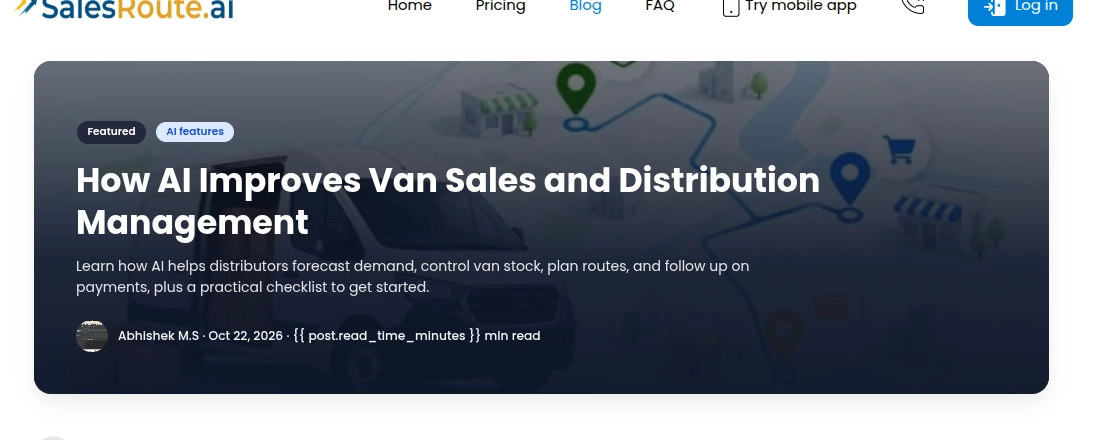
How AI Improves Van Sales and Distribution Management
Learn how AI helps distributors forecast demand, control van stock, plan routes, and follow up on payments, plus a practical checklist to get started.
 AI & Sales
Made Simple with SalesRoute.ai
In today's competitive distribution and sales environment, managing customer orders efficiently is critical for business success. Manual order tracking, delayed updates, and disconnected processes often result in errors, missed opportunities, and dissatisfied customers. SalesRoute.ai simplifies this challenge through its powerful Sales Order Management feature, enabling businesses to manage the complete order lifecycle from creation to delivery through a single, intelligent platform.
Route Optimization
How AI-Powered Route Planning Reduces Fuel Costs by 35% for FMCG Fleets
Discover how dynamic route optimization algorithms analyze real-time traffic, delivery windows, and order volumes to maximize van delivery efficiency.
 Expense Management
 in SalesRoute.ai: Simplify Business Spending with Complete Control
Managing expenses is an essential part of running a successful business. From travel costs and office purchases to operational expenses, every transaction impacts profitability. Without a structured system, tracking and analysing expenses can become time-consuming and prone to errors. SalesRoute.ai's Expense Management module helps organisations record, categorise, monitor, and analyse business expenses in one centralised platform. It provides better financial visibility